technology

What the 2026 National Restaurant Association Show Revealed About the Future of Restaurant Technology

The 2026 National Restaurant Association Show highlighted a shift in restaurant technology toward integrated, operational solutions that address labor challenges, cost management, and growing digital complexity. Innovations in AI, robotics, connected POS systems, and back-office tools focus on automating workflows, enhancing profitability, and improving consistency across kitchen operations, guest engagement, payments, and labor management. The event underscored that the future of restaurant technology lies in connected ecosystems simplifying management for operators rather than adding complexity.

https://restauranttechnologynews.com/2026/06/what-the-2026-national-restaurant-association-show-revealed-about-the-future-of-restaurant-technology/

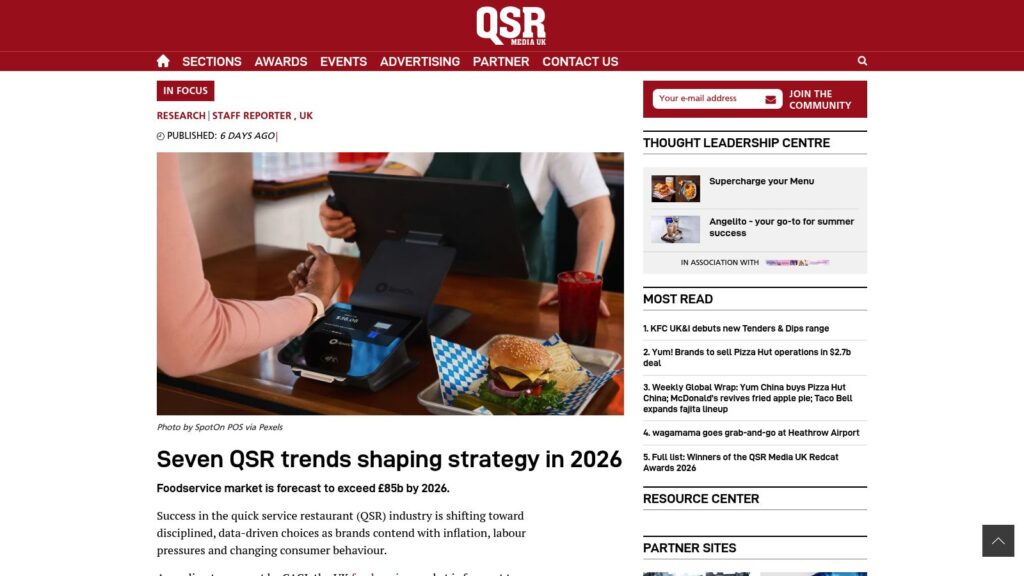
Seven QSR Trends Shaping Strategy in 2026

The UK quick service restaurant (QSR) sector is projected to exceed £85 billion by 2026, driven largely by delivery and drive-thru formats despite ongoing cost pressures from labor and food inflation. Key trends shaping strategy include advanced AI integration for demand forecasting and labour scheduling, multi-channel customer engagement emphasizing seamless digital and physical experiences, localized value pricing, increased focus on sustainability, and tailored health-conscious menu options. Operators are prioritizing data-driven, locally optimized decisions and balancing automation with human interaction to enhance speed, accuracy, and service quality amidst evolving consumer behaviors.

https://qsrmedia.co.uk/research/in-focus/seven-qsr-trends-shaping-strategy-in-2026

McDonald’s Says Its New AI Drive-Thru Handled 1 Million Orders with Humans Stepping in Just 10% of the Time

McDonald's is testing a new AI drive-thru ordering system called ArchIQ, developed with Google, at five U.S. locations, where it has already handled over 1 million orders with human intervention needed only about 10% of the time. The system not only processes orders in English and Spanish but also monitors restaurant operations to identify bottlenecks, aiming to enhance efficiency and speed up service as part of McDonald's broader “NEXT” growth plan.

https://www.thecooldown.com/green-tech/mcdonalds-ai-drive-thru-ordering-system/

McDonald’s Gives Google-Powered AI Drive-Thru a Second Chance

McDonald's is testing a new Google-powered AI drive-thru voice assistant called ArchIQ, which has completed around 90% of orders without human intervention across five U.S. restaurants. This initiative is part of the broader McDonald's > NEXT strategy focused on operational efficiency, food quality, and hospitality, aiming to integrate AI automation as a core component rather than an isolated test, following a previous less successful partnership with IBM. The approach balances faster service through automation while emphasizing the importance of human interaction in enhancing customer hospitality.

https://news.designrush.com/mcdonalds-next-google-archiq-ai-drive-thru

Drive-thru Usage Up, Speed of Service Down

In 2011, drive-thru usage at quick-service restaurants increased by 2 percent to 12.4 billion visits, with chains like McDonald's and Popeyes investing in technology and multiple lanes to improve speed of service despite overall slower service times. Drive-thrus remain the preferred ordering method at hamburger, Mexican, and chicken restaurants, prompting operators to focus on order accuracy, fast delivery, and portable menu items to enhance customer satisfaction and profitability.

https://www.qsrweb.com/articles/drive-thru-usage-up-speed-of-service-down/

The State of Mobile Ordering in QSR: Which Brands Are Winning, and Where Opportunity Still Lies

The 2026 mystery shopper report by Intouch Insight, featured in QSR Magazine, evaluates mobile ordering in quick-service restaurants across nine major brands, focusing on order accuracy, speed, service, and overall experience. Findings show mobile ordering apps generally perform well with high accuracy and customer satisfaction, but issues like technical glitches, unclear pickup instructions, and late orders still create friction, reducing satisfaction. Friendly staff interactions can mitigate some negative impacts, and dedicated pickup lanes improve speed and service at certain locations, highlighting ongoing opportunities for operational improvements in mobile ordering.

https://www.qsrmagazine.com/story/the-state-of-mobile-ordering-in-qsr-which-brands-are-winning-and-where-opportunity-still-lies/

How Technology Can Help QSRs Overcome Cost and Experience Challenges

Technology has become a crucial driver for quick-service restaurants (QSRs), helping them address cost challenges related to food and labor while enhancing customer experience through faster, accurate, and friendly service. Integrating purpose-built technology such as connected POS systems, AI-enabled devices, and back-office software enables QSRs to streamline operations and make data-driven decisions, with managed services further supporting ongoing maintenance and maximizing return on investment.

https://www.qsrmagazine.com/story/how-technology-can-help-qsrs-overcome-cost-and-experience-challenges/

Why The National Restaurant Association Show Has Become a Reality Check for Restaurant Technology

The 2026 National Restaurant Association Show marks a shift in restaurant technology from futuristic innovation toward practical solutions aimed at stabilizing margins, simplifying operations, and managing labor shortages amid economic pressures. Operators are increasingly prioritizing integrated, interoperable systems that can deliver measurable financial improvements and operational resilience, such as handheld POS devices and self-service kiosks, while AI is becoming embedded in back-end operational tools rather than consumer-facing features. This evolution reflects a more disciplined, financially grounded approach to technology investment as restaurants seek simplification and operational effectiveness in a challenging business environment.

https://restauranttechnologynews.com/2026/05/why-the-national-restaurant-association-show-has-become-a-reality-check-for-restaurant-technology/

Evolving Kitchen Operations Are Helping QSR Brands Navigate Supply and Cost Uncertainties

Quick-service restaurant (QSR) brands in India are evolving their kitchen operations to address rising input costs, labor challenges, and supply chain unpredictability while meeting growing delivery demand. This includes adopting smaller, more efficient kitchen footprints, leveraging cloud kitchens for operational flexibility, standardizing processes via automation, integrating inventory intelligence with AI-driven systems, and designing focused menus to improve efficiency and consistency—changes that are shaping which brands will successfully scale in the complex Indian market.

https://qsrmedia.asia/executive-insights/commentary/evolving-kitchen-operations-are-helping-qsr-brands-navigate-supply-and-cost-uncertainties

Quick Service Restaurant It Market Analysis By Application, Type, Technology, and Geography – Global Industry Outlook and Forecast 2026-2033

The Quick Service Restaurant (QSR) IT market, valued at $11.99 billion in 2026, is expected to grow at a CAGR of 6.34% from 2026 to 2035, reaching approximately $19.61 billion. This growth is driven by increasing adoption of digital technologies such as mobile ordering, AI, and cloud computing to enhance operational efficiency and customer experience, alongside rising investments and expanding applications across key regions including North America and Asia-Pacific. The market is characterized by rapid digital transformation, integration of innovative IT solutions, and a focus on sustainability, with strategic partnerships and regulatory compliance shaping its competitive landscape.

https://www.openpr.com/news/4492066/quick-service-restaurant-it-market-analysis-by-application

Scroll to Top