qsr

The QSR Growth Playbook: Strategies to Win in 2026

Q4 2025 saw rising competition and shifting consumer expectations in the QSR industry. To drive growth in 2026, QSRs should leverage dual limited-time offers, build loyalty ecosystems around routines, and capitalize on chicken’s versatility. Additionally, brands must innovate to compete on value and desire, while using beverage innovation as a high-frequency traffic driver.

https://www.numerator.com/resources/blog/qsr-growth-playbook/

What’s Driving the Beverage Boom, and How Restaurants Can Take Advantage

Beverage market booming; chains like Taco Bell and Chick-fil-A innovate. Non-alcoholic drinks projected over $25.5B in 2025. Success requires community connection, wellness trends, and flavor innovation. Effective marketing strategies are essential for standing out amidst competition, focusing on insights, engaging omnichannel efforts, and real-time optimization. Adaptation to customer needs drives long-term growth in the beverage sector.

https://www.qsrmagazine.com/story/whats-driving-the-beverage-boom-and-how-restaurants-can-take-advantage/

From Hybrid Fleets to Intelligent Orchestration: Why Delivery 3.0 Is About Systems, Not Robots

Delivery 3.0 revolutionizes restaurant logistics through hybrid orchestration, integrating autonomous technologies like drones and robots with existing delivery systems. This shift requires operators to build sophisticated dispatch intelligence to manage varied delivery modes effectively. Successful adaptation hinges on their ability to enhance real-time decision-making across diverse fleets, maximizing efficiency and profitability while meeting customer expectations for tracking and service. Fast-casual and pizza chains are likely to lead this transition due to their operational infrastructure and delivery needs. Operators must invest now in advanced systems to stay competitive as autonomous delivery evolves.

https://www.qsrmagazine.com/story/from-hybrid-fleets-to-intelligent-orchestration-why-delivery-3-0-is-about-systems-not-robots/

How AI Is Reshaping The Restaurant Industry — For Better And Worse

AI is increasingly integrated into the restaurant industry, enhancing customer service, streamlining operations, and personalizing experiences. Key changes include improved mobile app interactions, smoother drive-thrus through automation, and personalized kiosks. In kitchens, robots assist with food preparation, while AI handles menu design, pricing adjustments, and inventory management, decreasing waste and improving efficiency. AI advances marketing strategies, creates targeted promotions, and enhances delivery systems, ultimately increasing safety standards and expediting staff training. Overall, AI aims to improve restaurant profitability and customer satisfaction while reshaping workforce roles.

https://www.thetakeout.com/2064901/ai-changing-restaurant-industry-pros-cons/

Campaign: McDonald’s Ditches Menu Boards

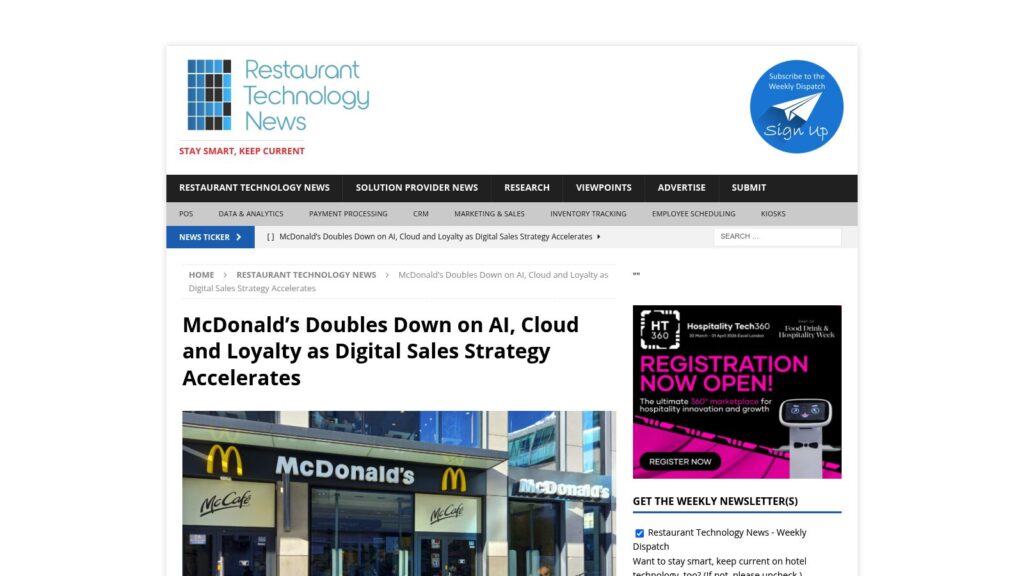
McDonald's Saudi Arabia launched the “McMenuless Challenge,” removing menu boards to highlight brand loyalty and customer memory. The viral campaign demonstrated the emotional connection to the brand but also underscored the importance of digital menu boards in quick service restaurants for operations, guidance, and upselling. Despite its success, the stunt reaffirmed the necessity of menu boards in QSR operations.

https://invidis.com/news/2026/01/qsr-mcdonalds-ditches-menu-boards-temporarily/

Restaurant Industry Experts Make Predictions for 2026

2026 restaurant trends shaped by “Me-Me-Me Economy” focus on hyper-personalization, AI integration, and health-oriented menus. Key predictions include: tech enhancing order accuracy, loyalty through personalization, emphasis on data integration, corporate catering as a marketing tool, utilizing guest feedback, evolving frontline roles, and inflation impacting operations and purchasing. Success hinges on integrating technology with hospitality to create a more personalized dining experience.

https://www.qsrweb.com/articles/restaurant-industry-experts-make-predictions-for-2026/

The $162 Billion Question: Why Restaurant Operators Confuse Activity With Efficiency

Article highlights $162B restaurant efficiency crisis due to 4-10% food waste and 144% turnover, linked to flawed kitchen design. Automation tech enhances productivity by 11% and reduces labor costs by 30%. Past inefficiencies now critical with rising wages; automation provides exact portions and consistency, addressing systemic waste.

https://www.qsrweb.com/press-releases/the-162-billion-question-why-restaurant-operators-confuse-activity-with-efficiency/

Why 2026 Is the Year of the AI-driven Restaurant

By 2026, AI in restaurants will shift from novelty to essential, addressing labor shortages and tight margins. Innovations like back-of-house automation and personalized customer tools will enhance operations and customer experience. Experts agree that AI adoption is crucial for success, as technology streamlines processes and drives growth amid economic changes, redefining hospitality through enhanced personalization without replacing human staff.

https://www.qsrweb.com/articles/why-2026-is-the-year-of-the-ai-driven-restaurant/

Vox AI Integrates Drive-thru Payments Through Adyen Partnership

Vox AI partnered with Adyen to launch Vox AI Pay, enabling drive-thru card payments directly at order terminals, improving transaction speed and reducing queues. The system integrates with major point-of-sale platforms, supports cashless payments, and aims to decrease processing fees. It will be demonstrated at the National Retail Federation Big Show 2026. Vox AI develops voice automation technology for quick-service restaurants, addressing labor challenges.

https://www.fdiforum.net/mag/featured/vox-ai-integrates-drive-thru-payments-through-adyen-partnership/

Scroll to Top