qsr

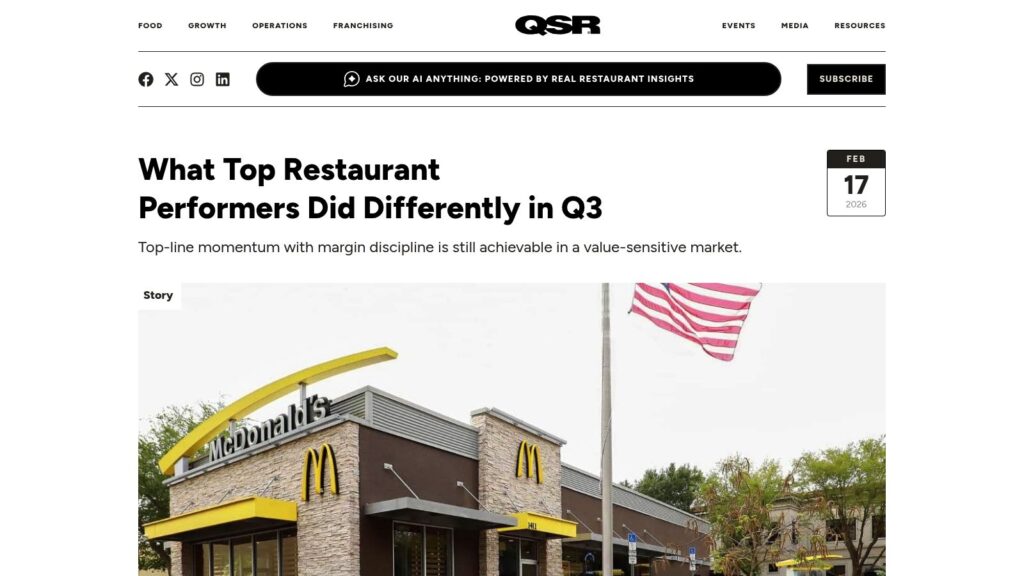
McDonald’s Making Major Drive-thru Change

McDonald's is leveraging technology, specifically AI, to enhance drive-thru efficiency and accuracy, addressing common customer complaints like slow service and order errors. By partnering with Google Cloud, McDonald's aims to improve operations across its 43,000 restaurants, utilizing AI tools to streamline processes. Initiatives include AI-powered systems for better order accuracy and plans for broader technological integration by 2026. This investment aligns with McDonald’s strategy to enhance digital services and customer experiences, amidst growing competition in the fast-food sector.

https://www.thestreet.com/restaurants/mcdonalds-bets-on-ai-in-2026-to-fix-a-major-problem

Artificial Intelligence in the Restaurant Industry Transforming Experiences, Operations, and Finances

Artificial intelligence (AI) is transforming the restaurant industry by enhancing customer experiences, optimizing operations, and improving financial management. AI tools like kiosks, chatbots, and predictive systems streamline workflows, reduce costs, and personalize service. However, challenges such as high implementation costs, data privacy concerns, and potential impacts on human interaction and employee morale remain significant barriers to widespread adoption.

https://www.scirp.org/journal/paperinformation?paperid=148794

How McDonald’s Is Integrating AI Across Restaurants Globally

McDonald's plans to integrate AI in 43,000 restaurants globally, partnering with Google for enhanced order accuracy, staff efficiency, and customer satisfaction. AI will help manage customer interactions and optimize kitchen equipment maintenance. Initiatives include voice AI for drive-throughs and computer vision for order verification. The collaboration with Google Cloud aims to accelerate technology adoption and improve customer engagement through modernized platforms.

https://technologymagazine.com/articles/how-mcdonalds-is-using-ai-to-boost-efficiency-and-workflows

What 2025’s Biggest QSR Traffic Surges Reveal About Dining Strategies for 2026

QSR trends in 2025 showed that standout discounts and culturally relevant promotions significantly boosted traffic for chains. Freebies and unique offers cut through competition, while pop-culture tie-ins generated momentum. Promotions such as Starbucks' Bearista merchandise demonstrated that premium items can also drive interest. Ultimately, while discounts dominate, food offerings still play a crucial role in attracting customers.

https://www.placer.ai/anchor/articles/what-2025s-biggest-qsr-traffic-surges-reveal-about-dining-strategies-for-2026

The QSR Growth Playbook: Strategies to Win in 2026

Q4 2025 saw rising competition and shifting consumer expectations in the QSR industry. To drive growth in 2026, QSRs should leverage dual limited-time offers, build loyalty ecosystems around routines, and capitalize on chicken’s versatility. Additionally, brands must innovate to compete on value and desire, while using beverage innovation as a high-frequency traffic driver.

https://www.numerator.com/resources/blog/qsr-growth-playbook/

What’s Driving the Beverage Boom, and How Restaurants Can Take Advantage

Beverage market booming; chains like Taco Bell and Chick-fil-A innovate. Non-alcoholic drinks projected over $25.5B in 2025. Success requires community connection, wellness trends, and flavor innovation. Effective marketing strategies are essential for standing out amidst competition, focusing on insights, engaging omnichannel efforts, and real-time optimization. Adaptation to customer needs drives long-term growth in the beverage sector.

https://www.qsrmagazine.com/story/whats-driving-the-beverage-boom-and-how-restaurants-can-take-advantage/

From Hybrid Fleets to Intelligent Orchestration: Why Delivery 3.0 Is About Systems, Not Robots

Delivery 3.0 revolutionizes restaurant logistics through hybrid orchestration, integrating autonomous technologies like drones and robots with existing delivery systems. This shift requires operators to build sophisticated dispatch intelligence to manage varied delivery modes effectively. Successful adaptation hinges on their ability to enhance real-time decision-making across diverse fleets, maximizing efficiency and profitability while meeting customer expectations for tracking and service. Fast-casual and pizza chains are likely to lead this transition due to their operational infrastructure and delivery needs. Operators must invest now in advanced systems to stay competitive as autonomous delivery evolves.

https://www.qsrmagazine.com/story/from-hybrid-fleets-to-intelligent-orchestration-why-delivery-3-0-is-about-systems-not-robots/

How AI Is Reshaping The Restaurant Industry — For Better And Worse

AI is increasingly integrated into the restaurant industry, enhancing customer service, streamlining operations, and personalizing experiences. Key changes include improved mobile app interactions, smoother drive-thrus through automation, and personalized kiosks. In kitchens, robots assist with food preparation, while AI handles menu design, pricing adjustments, and inventory management, decreasing waste and improving efficiency. AI advances marketing strategies, creates targeted promotions, and enhances delivery systems, ultimately increasing safety standards and expediting staff training. Overall, AI aims to improve restaurant profitability and customer satisfaction while reshaping workforce roles.

https://www.thetakeout.com/2064901/ai-changing-restaurant-industry-pros-cons/

Campaign: McDonald’s Ditches Menu Boards

McDonald's Saudi Arabia launched the “McMenuless Challenge,” removing menu boards to highlight brand loyalty and customer memory. The viral campaign demonstrated the emotional connection to the brand but also underscored the importance of digital menu boards in quick service restaurants for operations, guidance, and upselling. Despite its success, the stunt reaffirmed the necessity of menu boards in QSR operations.

https://invidis.com/news/2026/01/qsr-mcdonalds-ditches-menu-boards-temporarily/

Scroll to Top