Vox AI Raises $8.7 Million to Bring Fully Autonomous Voice Ordering to Quick-Service Restaurant Drive-Thrus

Vox AI raised $8.7 million for its fully autonomous voice ordering platform for quick-service restaurants (QSRs). With multilingual support and no human oversight needed, it aims to enhance drive-thru efficiency and integrate directly with existing POS systems. Early deployments reportedly yield up to a 17x ROI by improving customer service and sales. Competitors are emerging, but Vox AI’s focus on real-time, noise-adaptive solutions positions it uniquely in the growing QSR automation market.

https://restauranttechnologynews.com/2025/08/vox-ai-raises-8-7-million-to-bring-fully-autonomous-voice-ordering-to-quick-service-restaurant-drive-thrus/

Why Fast Food Isn’t One-Size-Fits-All Anymore

Fast food market dynamics are changing; it’s becoming more polarized, targeting specific consumer segments rather than a one-size-fits-all approach. Younger generations, affluent consumers, and regional behaviors shape preferences, emphasizing the need for tailored marketing strategies. QSRs must innovate, utilize loyalty programs, and balance value with premium offerings to engage diverse audiences effectively.

https://www.qsrmagazine.com/story/why-fast-food-isnt-one-size-fits-all-anymore/

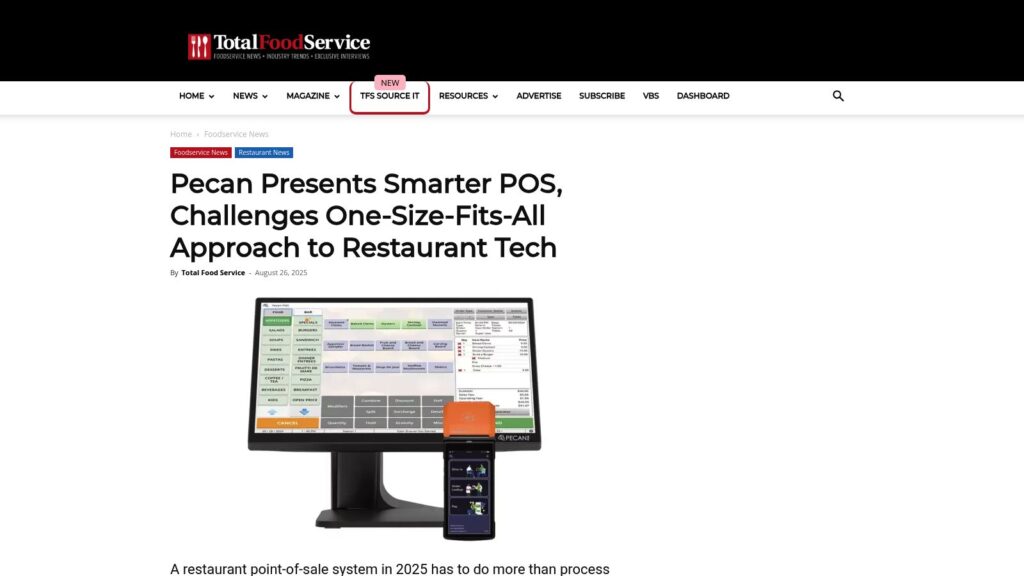
Pecan Presents Smarter POS, Challenges One-Size-Fits-All Approach to Restaurant Tech

Pecan POS offers a flexible, customizable point-of-sale system tailored for diverse restaurant operations, challenging one-size-fits-all tech. Founded in 2018, it prioritizes adaptability and dealer control, supporting modular integration and various business models. As the industry evolves under pressure, Pecan emphasizes service, relationships, and specific operator needs, providing innovative solutions like cost-efficient self-ordering kiosks. Its success stems from responsive development and empowering small to medium operators while maintaining focus on the unique challenges they face.

https://totalfood.com/pecan-smarter-pos-challenges-one-size-fits-all-tech/

Self-Service Payment Kiosks Market Analysis Report

Global self-service payment kiosks market to grow at 6.03% CAGR (2024-2030), driven by digital transformation, AI, and contactless payments. North America leads with 44% market share; food & beverage is the top end-user sector. Key players include Elo and Acrelec, focusing on AI behavior enhancements. The Asia-Pacific region shows rapid growth, influenced by urbanization and digital payment demand. Key trends include increased contactless payment adoption, AI integration for personalized experiences, and operational efficiency improvements.

https://www.globenewswire.com/news-release/2025/08/25/3138239/0/en/Self-Service-Payment-Kiosks-Market-Analysis-Report-2025-2030-AI-and-Machine-Learning-Integrations-Revolutionizing-Self-Service-Kiosks-for-Enhanced-User-Experience.html

New eBook Reveals How Quick Service Restaurants Are Scaling Smarter With Handheld POS and Self-Service Kiosks

New eBook examines how quick-service restaurants (QSRs) enhance efficiency with handheld POS and self-service kiosks, highlighting benefits like faster service, increased sales, and improved customer experiences. Key insights reveal widespread adoption, significant time and cost-saving advancements, and the critical role of real-time data. The guide offers practical strategies for QSRs looking to modernize, enhance profitability, and improve operations.

https://restauranttechnologynews.com/2025/08/new-ebook-reveals-how-quick-service-restaurants-are-scaling-smarter-with-handheld-pos-and-self-service-kiosks/

Fast Food Brands Fire up AI Despite Challenging Backdrop

Fast food chains like McDonald’s, Chipotle, and Yum Brands are adopting AI to streamline operations amidst financial challenges. These brands are embedding AI in workflows to enhance customer and employee experiences, reduce costs, and improve efficiency. McDonald’s is using Google Cloud for edge computing to better predict equipment needs, while Yum leverages its AI platform Byte to simplify processes. Despite recent sales declines, these companies continue prioritizing technology investments to enhance performance and engagement.

https://www.restaurantdive.com/news/fast-food-brands-AI-strategy-financial-challenges/757468/

McDonald’s Plans to Change Customer Waiting Times

McDonald’s is implementing a “digital transformation” strategy to reduce customer wait times by over 50% through a new “Ready on Arrival” system that streamlines mobile order pickups. This geofencing technology notifies staff to prepare orders when customers are nearby. This initiative is part of a broader upgrade to enhance efficiency across 43,000 restaurants with AI technology to improve accuracy and manage workflow stress. McDonald’s aims to increase loyalty program users from 185 million to 250 million by 2027.

https://www.newsweek.com/mcdonalds-plans-lower-customer-waiting-times-2114080

McDonald’s Digital Transformation is Redefining Fast Food

McDonald’s “Digitizing the Arches” initiative focuses on transforming the fast food experience through digital innovation and customer engagement. The strategy integrates AI and IoT technologies to enhance operations, improve food quality, and streamline order fulfillment. Key advancements include the Edge platform for smarter restaurants, AI-powered Accuracy Scales for order accuracy, and an enhanced loyalty program that increases customer visits. McDonald’s aims to modernize operations by replacing legacy systems with cloud-based solutions for greater efficiency and integration. Overall, the transformation seeks to leverage data and technology to elevate customer experiences and business performance.

https://www.processexcellencenetwork.com/digital-transformation/news/mcdonalds-digital-transformation-is-redefining-fast-food

Chipotle and Cava Invest $25 Million in Hyphen to Advance Restaurant Automation

Chipotle and Cava invested $25 million in Hyphen, an automation startup, to improve restaurant operations. Hyphen’s technology can process 350 meals per hour with 99% accuracy, reducing labor costs and waste. Both companies aim to enhance efficiency in response to growing digital order demands, addressing labor shortages while maintaining a human touch in service. The investment will scale Hyphen’s production and support, pushing for differentiated service in a competitive market.

https://restauranttechnologynews.com/2025/08/chipotle-and-cava-invest-25-million-in-hyphen-to-advance-restaurant-automation/

How AI Turning Labor From Cost Center Into Growth Driver for QSRs

AI is transforming labor management in QSRs from a cost center to a growth driver by optimizing staffing and scheduling through accurate demand forecasting. A webinar will cover how AI can enhance workforce productivity and compliance while improving service and sales. Additionally, it will address labor optimization techniques using unique demand data, hosted by experts from Deputy and QSRweb.com.

https://www.qsrweb.com/articles/how-ai-turning-labor-from-cost-center-into-growth-driver-for-qsrs/

Scroll to Top