McDonald’s New Structure: a Hospitality Technology Innovation Blueprint |

McDonald’s is restructuring to enhance agility and decision-making, led by CEO Chris Kempczinski, aiming to overcome stagnant sales and increased competition. A new Chief Restaurant Experience Officer role will streamline operations across various departments, ensuring innovation aligns with consumer demand. The company is shifting to an operator-first mindset, focusing on seamless technology integration in restaurants. This transformation emphasizes category ownership for better market responsiveness. The goal is to accelerate product development and improve customer experiences amid economic pressures and changing dining habits. Overall, it’s a call for the broader restaurant industry to align innovation with real-world operations.

https://restauranttechnologynews.com/2025/03/mcdonalds-new-structure-a-hospitality-technology-innovation-blueprint/

How McDonald’s Is Integrating AI Across Restaurants Globally

McDonald’s is integrating AI across its 43,000 restaurants globally with the help of Google, aiming to enhance order accuracy, staff efficiency, and customer satisfaction. The technology will support operations by managing kitchen equipment and improving customer interactions at drive-throughs and kiosks. AI will also help with predictive maintenance of appliances and could introduce a virtual manager to handle administrative tasks. This strategy aims to alleviate staff stress and refine customer experiences.

https://technologymagazine.com/articles/how-mcdonalds-is-using-ai-to-boost-efficiency-and-workflows

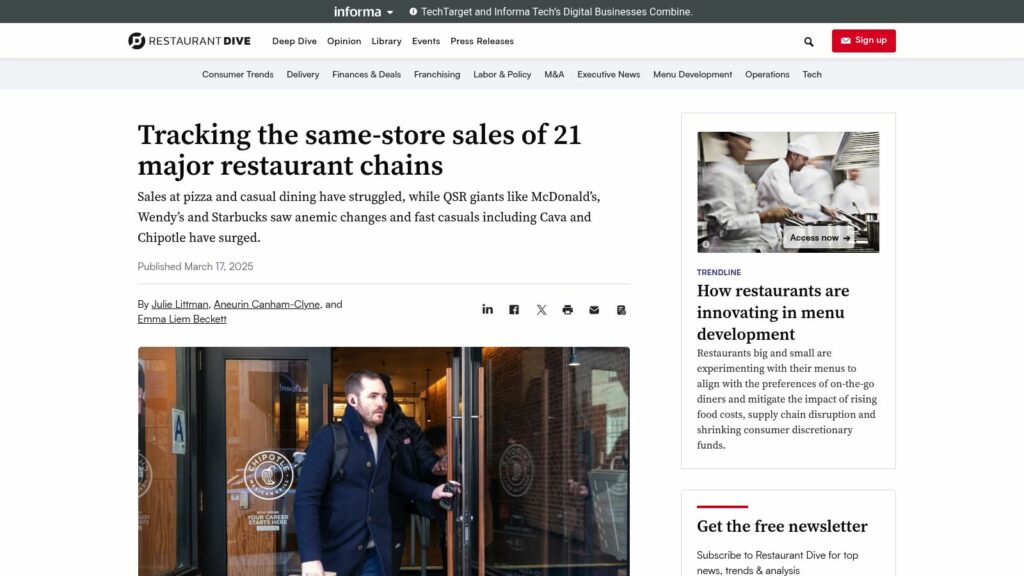
Tracking the Same-store Sales of 21 Major Restaurant Chains

Same-store sales analysis for 21 restaurant chains shows casual dining and pizza struggling, while QSRs like McDonald’s and Wendy’s have mixed results. Fast casuals like Cava and Chipotle thrive. Chili’s reports 31% growth due to value-focused marketing, while chains like Applebee’s and Olive Garden face sales declines. Innovations and remodeling strategies are being employed across the sector to improve performance.

https://www.restaurantdive.com/news/tracking-same-store-sales-21-major-restaurant-chains/742371/

QSR Psychology: The 4 Hidden Drivers of Interest and Action

QSR psychology identifies four key drivers influencing customer behavior:

  1. Rational: Intrinsic motivation linked to knowledge and self-improvement, prompting evaluations of nutritional information and brand expertise.
  2. Sensory Exploration: Intrinsic curiosity fostering a desire for new experiences through innovative offerings and limited-time promotions.
  3. Wisdom of the Tribe: Extrinsic motivation driven by social acceptance, where dining choices reflect group dynamics and community values.
  4. Instinct and Impulse: Extrinsic rewards aiming for immediate gratification, often triggered by emotional and sensory engagement in marketing.

Marketers should align strategies with these drivers to enhance customer connection and drive sales, moving beyond conventional factors like price. Understanding customer motivations can lead to significant shifts in menu, experience design, and marketing.

https://www.qsrmagazine.com/story/qsr-psychology-the-4-hidden-drivers-of-interest-and-action/

Boosting QSR Sales Through the Power of POP Marketing

POP marketing boosts QSR sales by driving impulse buys through effective displays at high-traffic areas. Key tactics include digital menu boards, countertop displays, promotional signage, and interactive kiosks. For POP to succeed, it needs high visibility, direct influence on choices, and effective placement to trigger purchases. Simplicity and brand consistency in design are crucial. Not all promotions succeed, but successful POP can create excitement and additional sales, demonstrating the potential impact of effective marketing strategies in the QSR industry.

https://www.qsrmagazine.com/story/boosting-qsr-sales-through-the-power-of-pop-marketing/

Revolutionizing Asia’s QSR Scene: How Indian Brands Are Leading the Charge

Indian brands are revolutionizing Asia’s Quick Service Restaurant (QSR) market through innovation, technology, and culturally infused offerings. They excel in localizing traditional flavors, integrating AI and automation for efficiency, and prioritizing sustainability. Merging heritage with global trends, Indian QSRs are expanding successfully across markets while setting new industry standards. Their adaptability positions them as leaders in shaping the future of QSRs in Asia.

https://qsrmedia.asia/food-services/commentary/revolutionizing-asias-qsr-scene-how-indian-brands-are-leading-charge

Saudi Arabia Quick Service Restaurants (QSR) Market

Saudi Arabia’s Quick Service Restaurant (QSR) market is projected to grow from $9.23 billion in 2024 to $16.62 billion by 2033, with a CAGR of 6.78%. Drivers include a young, tech-savvy population, increasing disposable incomes, and government support via initiatives like Vision 2030. The sector is competitive, with global brands like McDonald’s and KFC alongside local adaptions. Challenges include rising operational costs and intense competition. Technological advancements in delivery and service systems are enhancing customer experience. New market entries are expanding rapidly, exemplified by recent openings from Dunkin’ and Gong Cha.

https://www.globenewswire.com/news-release/2025/03/11/3040388/28124/en/Saudi-Arabia-Quick-Service-Restaurants-QSR-Market-Forecasts-2025-2033-Fierce-Rivalry-Between-Global-Chains-and-Regional-Players-Defines-the-Landscape-and-Spurs-Innovations.html

New Report Reveals Restaurant Training Trends for 2025

New 2025 restaurant training report shows:

  • Increased budget tracking correlates with financial support.
  • Hourly employee training drops to one hour/month (up to 58% decrease).
  • AI enhances efficiency; only 8% are advanced users.
  • 61% prioritize basic skills training, up 25% from 2024.

The report emphasizes the strategic use of technology and measurable outcomes for operational success amid economic challenges.

https://www.qsrmagazine.com/news/new-report-reveals-restaurant-training-trends-for-2025/

McDonald’s Gives Its Restaurants an AI Makeover

McDonald’s is modernizing its 43,000 restaurants using AI to improve order accuracy and equipment maintenance. This initiative, in partnership with Google Cloud, aims to ease operational stress for staff and enhance customer experience amidst declining sales. The new technology includes internet-connected kitchen equipment, predictive maintenance using edge computing, and AI-driven tools for managers. McDonald’s also plans to introduce computer vision for checking order accuracy at the drive-thru and generative AI for administrative tasks. Overall, these advancements are designed to boost customer loyalty and operational efficiency.

https://www.wsj.com/articles/mcdonalds-gives-its-restaurants-an-ai-makeover-2134f01e

Scroll to Top