McDonald’s Reimagines Future of Loyalty With AI
McDonald’s introduces “Magic Stories,” an AI-driven feature in its app that transforms family visits into personalized animated narratives, enhancing engagement through storytelling. Developed by TBWA\Helsinki and TBWA\NEBOKO, this innovation aims to deepen brand loyalty by creating memorable experiences with every interaction, unlocking new story chapters and virtual collectibles. The project emphasizes collaboration across creative, tech, and legal teams to ensure quality and reliability in storytelling.

https://lbbonline.com/news/McDonalds-Future-Loyalty-AI

Fast Food Market Size, Share, Trends, Analysis, And

Global fast food market projected to grow from $304.6B in 2025 to $554.6B by 2034, at a 6.9% CAGR. Growth driven by urbanization, consumer demand for convenience, digital ordering, and healthier menu options, despite health and regulatory challenges. Key trends include plant-based foods, AI engagement, ghost kitchens, automation, and sustainability. Regulatory pressures prompting product reformulation. Major markets segmented by service, product, end-user, and region.

https://www.globenewswire.com/news-release/2025/06/24/3104497/0/en/Fast-Food-Market-Size-Share-Trends-Analysis-and-Forecast-2025-2034-Global-Industry-Growth-Competitive-Landscape-Opportunities-and-Challenges.html

KFC, Pizza Hut China Operator Launches AI Tool for Managers

Yum China, operator of KFC and Pizza Hut, launched Q-Smart, an AI assistant for store managers to assist in labor scheduling, inventory management, and quality inspections. In pilot testing, Q-Smart will expand its integration with wearables. This reflects a shift in restaurant AI focus from customer-facing roles to operational tasks, driven by rising costs and staffing challenges, while emphasizing AI’s role in augmenting rather than replacing human workers.

https://www.techinasia.com/news/kfc-pizza-hut-china-operator-launches-ai-tool-for-managers

Insight Must Sit at the Center of Any Brand, Says Former McDonald’s Insight Director

Sandrine Seksik, former insights director at McDonald’s France, emphasizes the importance of integrating insights into brand strategy rather than treating them as a separate department. Her team played a crucial role in decision-making and innovation, particularly in enhancing digital ordering and adapting to local dining habits. Insights drove strategic planning and operational changes, enabling McDonald’s to thrive during the pandemic. She advocates for building relationships with CMOs and focusing on continuous data analysis to align insights with business objectives, which is essential for a consumer-driven approach in an increasingly data-rich environment.

https://www.thedrum.com/news/2025/06/18/insight-must-sit-the-center-any-brand-says-former-mcdonald-s-insight-director

The Intersection of Technology and Service to Help QSRs Win

QSRs face challenges but remain optimistic by adopting technology to enhance efficiency and customer satisfaction. They must integrate AI and digital solutions to manage diverse consumer demands and streamline operations. Updating technology, such as AI-powered kiosks and communication systems, can improve order accuracy and speed, addressing consumer expectations for reliability, variety, and personalization in a competitive market.

https://www.qsrmagazine.com/story/the-intersection-of-technology-and-service-to-help-qsrs-win/

How the Latest Technology, AI Are Transforming Fast-food Dining

AI and advanced technologies are transforming quick-service restaurants (QSRs) by enhancing customer convenience, order accuracy, and personalized experiences. Key innovations include AI-enabled touchpoints, smart displays, and self-service kiosks, improving both staff efficiency and customer satisfaction. Digital menu boards allow real-time updates, aiding upselling and reducing errors, while self-service kiosks are preferred by consumers for their ease. Overall, the integration of technology in QSRs is vital for competitiveness and operational success.

https://www.qsrweb.com/blogs/how-the-latest-technology-ai-are-transforming-fast-food-dining/

QuikTrip Revamping Self-serve Beverage Program

QuikTrip is overhauling its self-serve beverage program, introducing new machines for fountain, tea, and frozen drinks to enhance flavor selection and customization. The rollout is expected to complete by summer 2026 across 21 states, targeting greater consistency and an impressive total of 40 drink options. The update reflects QuikTrip’s ambition to become a leader in the premium beverage sector.

https://www.cstoredive.com/news/quiktrip-self-serve-beverage-program/750337/

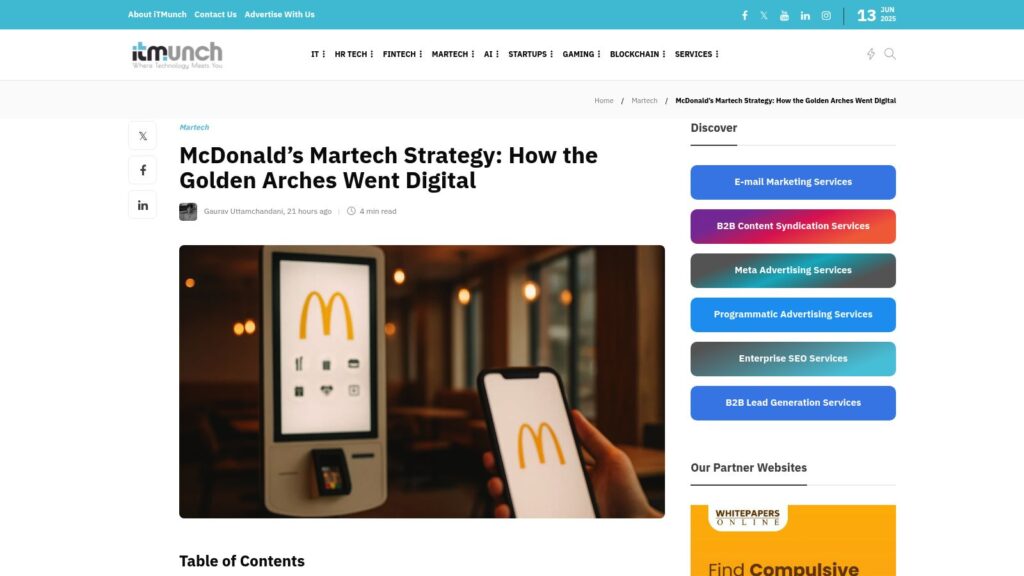
McDonald’s Martech Strategy: How the Golden Arches Went Digital

McDonald’s has digitally transformed into a leading QSR through a comprehensive Martech strategy that includes an advanced mobile app, AI-driven drive-thrus, and dynamic digital menus. Its focus on personalization, loyalty programs, and data analytics helps enhance customer interactions and streamline operations. Key features include personalized offers, gamified rewards, and optimized inventory management. By leveraging AI and data privacy measures, McDonald’s achieves localized marketing that resonates globally, improving customer engagement and retention.

https://itmunch.com/mcdonalds-martech-strategy-digital-transformation/

Automation in Restaurants: Enhancing Service, Not Replacing It

Restaurants are increasingly adopting automation, with 85% of leaders planning investments to boost efficiency. Consumers are mixed, preferring human interaction but accepting automation for improving service during staff shortages. Effective automation should empower staff, enhance efficiency without replacing human touch, facilitate faster service, and personalize customer experiences. Examples include self-service kiosks, digital waitlists, and mobile POS systems. The goal is to strike a balance, using technology for repetitive tasks while maintaining warm service, ultimately enhancing customer loyalty and satisfaction.

https://www.theolympian.com/news/business/article308214190.html

Use Your Data or Lose Your Margins

QSR profit margins are under pressure due to rising food and labor costs, potentially worsened by tariffs. To survive, restaurants must leverage existing technology and data to transform these costs into assets. By analyzing data from POS systems and integrating various management tools, operators can reduce waste, optimize staffing, and forecast demand effectively, which leads to cost savings and improved customer experiences. Ultimately, the key to resilience lies in data-driven decision-making and seamless system integration to enhance operational efficiency and profitability.

https://www.qsrweb.com/blogs/use-your-data-or-lose-your-margins/

Scroll to Top